
FAQ & Pricing
What can somatic coaching help with?
Here are a few possible goals for coaching, but the sky is the limit as to what people focus on in coaching. You could do somatic coaching to:
- feel more at ease in your body
- feel more equipped in working with pain and discomfort in the body
- feel more present and alive in yourself
- feel more present, authentic and connected in your relationships
- show up more powerfully in your work, art or organizing
- feel more comfortable setting boundaries, making centered requests, declines, etc.
- feel more confident in your self, at work & in relationships
- heal from impostor syndrome
- create a more positive relationship with your body
- find deeper purpose in life
- deepen your sense of resilience or joy to be better able to navigate life’s challenges
- access and express a wider range of emotions
- express your creativity and voice
What are you longing for?
What can I expect in a coaching session?
We start with a free 30 minute discovery call to get to know each other a bit, to answer any questions you might have, and get a feel if we are a good match for coaching.
Sessions are 60 minutes/each via Zoom. I work in 10-session arcs, focusing on 1-3 goals for each arc. In the first session, we generally do a deep dive into your dreams and longings for a desired future self, as well as what you’re seeing as your main obstacles and, together, define 1-3 primary goals for our work together for the first 10 sessions.
Sessions are client-led/generated. As a somatics coach, my role is as ally/partner, supporting you on your journey towards a desired future (aka embodied transformation). Within the general scope of the goals we outline in our first call, I will open each session asking you what you would like to focus on in that particular session. It can be helpful to spend a little time before sessions reflecting on what material you’d like to dive into that day that connects to your overarching goals. I aim to hold a compassionate container for you to explore within and, as appropriate, offer suggestions on how we might engage or work with a particular topic or content, drawing on my somatic lens and training in different somatic methodologies. This might include deeper processes of getting to know how old habituated patterns work in your body or trying on new practices to make available new embodied options.
Consent is my top priority: If anything is ever not feeling right or is confusing in a session, I welcome you to let me know and we can change directions or pause and clarify.
What's the difference between individual somatic coaching vs. the Somatic Survival Skills groups vs. Cranky Bodies Movement Club and where should I start?
I’m happy to talk this through on a call, and I’ll offer a brief overview here.
1:1 somatic coaching is a great option if there’s an area of your life you’d like to change or transform. This might look like a desire to feel more connected to your body, more present, self-compassion, or resourced—or to support specific personal, creative, activist, or professional goals you’re working toward.
In coaching, we have the space to go deep. We explore how your embodied patterns are showing up in present time, clarify your longings, and understand what may be getting in the way. From there, we cultivate purposeful somatic practices that are tailored to you and directly support your goals. While coaching can sometimes feel similar to therapy in terms of the topics that arise, the focus is less on talking and more on what’s emerging through the body and felt sense, along with identifying which somatic practices will best serve you.
Somatic Survival Skills groups are a good fit if you want to learn and experience the Strozzi/generative somatics methodology more deeply within a group setting. These groups are primarily learning spaces, rather than process-oriented coaching spaces. While personal material may emerge, the emphasis is on understanding the theory of embodied transformation and practicing a specific set of somatic tools together. Ideally, combining a Somatic Survival Skills group with 1:1 coaching offers the best of both worlds. If resources are limited, I usually recommend starting with a group to learn the core methodology, and then weaving in individual coaching if and when it feels right.
Cranky Bodies Movement Club groups are accessible, community-based spaces, specifically for folks living with chronic pain, illness, or disability. They offer a very gentle, playful introduction to somatics and choose-your-own-adventure movement. We don’t teach the underlying Strozzi somatic theory of change in these spaces. Instead, the short somatic “snacks” we weave in are meant to help us feel more connected to our bodies, the earth, and each other—and to serve as a kind of somatic first aid in these trying times. If you identify with these experiences, you’re warmly invited to drop into a Cranky Bodies group anytime. They’re free! You can sign up here.
Feel free to sign up for a free intro call if you’d like to discuss any of this more!
How many sessions will I need?
I generally work in a series of 10-session arcs, focusing on 1-3 goals for each arc. In the first session, we generally do a deep dive into your dreams and longings, as well as what you’re seeing as your main obstacles and, together, we define 1-3 primary goals for our work together for the first 10 sessions. We continue on from there, as it serves you, usually with a commitment to 5-10 sessions at a time. Often, as the body begins to unwind and embodied transformation emerges, new longings will surface. Similar as to how one might engage with therapy, we can continue working together as long as you’re finding our work together useful and supportive. Conversely, even though we might agree to doing multiple sessions at a time, if you ever feel like coaching isn’t working for you, you’re always welcome to end our work (ideally with 48 hours notice).
Somatic coaching might be a good match for you if...
- if you are looking for a more embodied approach to healing and transformation and
- are willing to dig deep to build an awareness of the patterned behaviors that have shaped you
- willing to try out somatic/body-based practices during sessions and daily at home, in between our sessions. I can’t stress this piece enough! (Note: we can adapt all practices to work for your body.)
- have a sense of where you’d like to be and yet are feeling stuck in some way.
Somatic coaching is not a good fit if...
…if you’re currently in crisis or struggling with depression, anxiety, or another mental health diagnosis and would benefit from a specific kind of care and expertise that addresses these experiences directly. It’s also not a great fit if you’re mostly looking for a talk-based therapist. ***While somatics work can delve deep and be incredibly transformative, please note: I’m not a therapist and this is not psychotherapy. Though if you’re working with a therapist, coaching often works very well in tandem.***
How much does individual somatic coaching cost?
Clients typically begin with a 10-session package, then continue in 5- or 10-session increments to allow time for deeper exploration, practice and integration. After your initial 10 sessions, I’m open to shorter packages if that better fits your needs.
Sessions are usually weekly or biweekly, which helps support depth and continuity. If this cadence isn’t possible for you, we can talk about other options that work for your schedule and budget. Many clients continue coaching on an ongoing basis.
Please use the Green Bottle method below to choose the tier that fits you best.
10-session package (60-min):
$1200 – tier 1
$1000 – tier 2
$800 – tier 3
5-session package (60-min):
$625 – tier 1
$525 – tier 2
$425 – tier 3
Payment plans are available.
Payment can be sent via personal check, Zelle @ reganpb@gmail.com or Venmo @Regan-Brashear. (Be sure to note what it’s for ).
Who do I work with?
Anyone with a genuine desire for embodied transformation! In our discovery call, in addition to answering any questions you might have, it’s a good time for each of us to get a gut feel of whether we would work well together. I’ve tried to give an honest reflection of who I am and what I’m about on this website. If after reading my “About me” page, you feel a resonance, please reach out and let’s book a discovery call.
I have a particular interest in supporting (and personal lived experience):
-
folks living with a complicated body, be that chronic illness/pain/disability, etc…,
-
those who identify as larger-bodied or fat, and are interested in feeling more ease, joy, empowered, and access to dignity in your body
-
white-identified folks who are looking deeply at how white supremacy culture shapes them and are seeking to contribute in a sustainable way to multiracial movements for collective liberation,
-
those who identify as queer, genderqueer or nonbinary,
-
filmmakers, writers and other creatives,
-
activists and organizers,
- educators and academics,
-
those who have been touched deeply by grief,
- introverts, shy folks, people pleasers, and “highly sensitive” people are very welcome!
Where can I learn more about somatics?
Be sure to visit my About Somatics page for an overview of the methodology.
You can watch a short video overview with one of my teachers, Staci Haines, explaining the Strozzi approach to Somatic Transformation.
For more on the methodology, this offers an excellent overview about “What is Somatics?” here.
Check out my Resources page for loads more! (Coming soon!)
A note on access
My intention is to make individual coaching and group calls as accessible as possible. What this means currently is all calls happen on Zoom with the live transcript and caption options enabled. I’m happy to provide audio recordings of any written materials that we may use or written recordings of any audio files that I may offer. We can adapt all somatic practices for your body, including using somatic imagination for practices that might not be available to your body at this time. I welcome and encourage feedback on what would best support your experience.
Green Bottle Method Sliding Scale - A Tool for Economic Justice
In an attempt to align my fees with my values and to make my work as accessible as possible, while still being able to survive as a person living with a chronic illness, I use the Green Bottle Method to price my classes, groups and individual coaching. Many thanks to Alexis J. Cunningfolk for developing this model and to Holly Poole-Kavana, for her clear and concise summary of the model that follows:
Please read to the end of this page to determine your appropriate fee. A sliding scale is a tool for building economic justice, and it requires your active participation. If a sliding scale is implemented effectively, everyone pays a similar percentage of their income for the same products or services. A wide range of payment options across the scale promotes broader accessibility, while insuring fair compensation to the producer. Paying according to one’s available resources creates a more equitable system for pricing of products and services.
Sliding scales are often based on individual income levels, with people of higher incomes paying more. However, many factors complicate and affect our financial status. Some groups of people have costs that the larger population does not. Others have access to resources that are not always reflected in their lifestyle choices and income levels. Please consider both your class background and earning power when choosing your share payment.
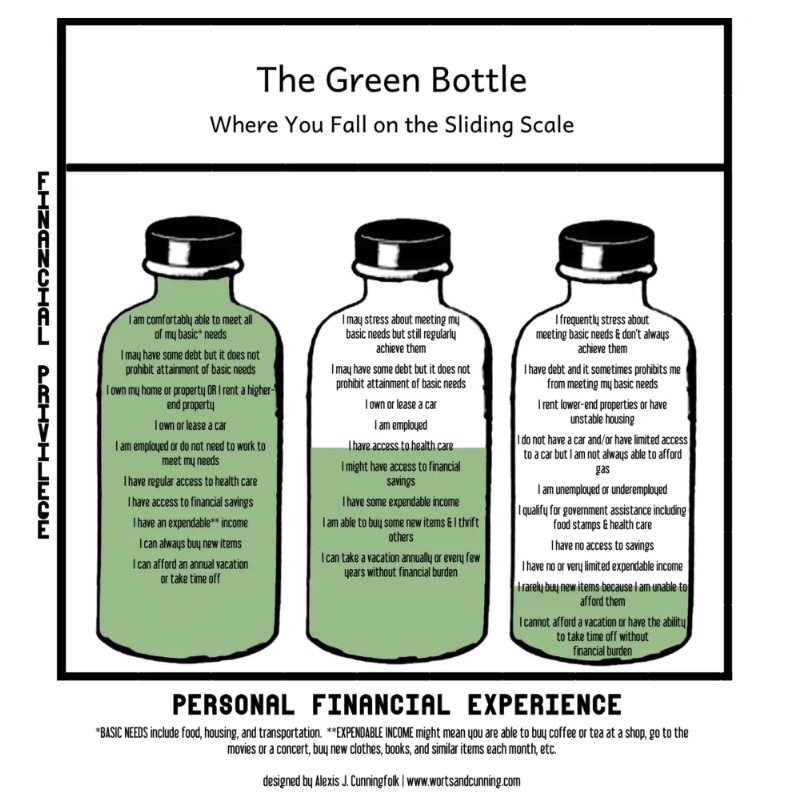
Consider paying less on the scale if you..
- are supporting children or have other dependents
- have significant debt
- have medical expenses not covered by insurance
- are eligible for public assistance
- have immigration-related expenses
- are an elder with limited financial support
- are an unpaid community organizer
- are a returning citizen who has been denied work due to incarceration history
- experience discrimination in hiring or pay level
- are descended from enslaved people or Native American Indians (I recognize that much of my privilege has come at the expense of these communities)
Consider paying more on the scale if you:
- own the home you live in
- have investments, retirement accounts, or inherited money
- travel for recreation
- have access to family money and resources in times of need
- work part time or are unemployed by choice, including unemployment due to full-time school in a degree-earning program
- have a relatively high degree of earning power due to level of education (or gender and racial privilege, class background, etc.) Even if you are not currently exercising your earning power, I ask you to recognize this as a choice
The scale is intended to be a map, inviting each of us to take inventory of our financial resources and look deeper at our levels of privilege. It is a way to challenge the classist and capitalist society we live in and work towards economic justice on a local level.
Please also understand that while I desire to make this work as affordable and accessible as possible, I am a person with a chronic illness and chronic pain, a dynamic disability that fluctuates day to day. While my experience navigating pain and coming home to my complicated body has brought, along with its challenges, many gifts of insight and compassion which benefit and inform my work with clients, it doesn’t allow me to pack my schedule to the brim with many sessions in a day which is how many coaches are able to financially sustain themselves in this profession.
When deciding what you can afford as far as my sliding scale, please take these factors into consideration and know that the more people are able to pay at the higher end of my scale, the more this supports my ability to offer this work at all, as well as my ability to offer sessions to individuals with little to no access to financial resources.
Thank you in advance for your integrity around this. Payment plans are available.
And while I ask you to take these factors into consideration, please don’t stress about it. Pay what feels right to you. I will not ask questions or quiz you on your payment choices.
If you are ever interested in a class presented through Welcome Home Somatics, but it feels cost-prohibitive to you, even within the sliding scale offered, please reach out and I’ll try my best to make it work for you.
If you are financially on the “full bottle” left end of the spectrum and would like to donate towards my being able to support more clients with less financial resources, here are platforms you can send donations through, please label them as a “Green Bottle Donation” so I can set the aside for when they are needed:
Zelle @ reganpb@gmail.com (preferred)
Venmo: @Regan-Brashear
Thank you in advance for paying it forward to support your community.
How to send payment
Payment can be sent via Zelle @ reganpb@gmail.com (preferred method) or Venmo @Regan-Brashear or personal check. Payment plans are available.
Redistribution
10% of Welcome Home Somatic’s net income is donated, split between the Amah Mutsun Tribal Band Land Trust and the Sameer Project, a Palestinian-led effort to bring food and medical aid to the people of Gaza.